Resources

News, technical documentation, and international network: Find all the information you need here to learn more about ARDES, its products, and its global presence.

News

Trade shows, partnerships, new products: Stay up to date on ARDES and its international network.

International Network

Learn about ARDES's presence on five continents and our network of partner distributors.

Videos and Technical Specifications

Video tutorials, user guides, and technical data sheets: all the resources you need to use your equipment properly.

FAQ

Answers to the most frequently asked questions about our identification loops and injection equipment.

Need to take it a step further?

Visit our product pages for complete technical data sheets, or contact our team directly with any specific questions.

Check out our video tutorials and reviews

FAQ

Here you'll find answers to the most frequently asked questions about our animal identification solutions and our veterinary injection equipment

Injection Equipment

Syringes, paint spray guns, and accessories: everything you need to know to use and maintain your equipment properly.

Turn the handle on the sprayer to set the desired dose: align the piston with the corresponding mark on the tank. This adjustment is made only once before each use, ensuring consistent accuracy throughout the treatment.

Once the syringe is filled, turn the stop nut to the volume to be injected, as indicated on the brass shaft. For example, to inject 15 cc using a 20 cc syringe, set the nut to 15 cc: this will leave 5 cc in the syringe after injection. This system ensures precise and reproducible dosing.

The choice depends on two factors: the animal’s size and the volume of the product to be injected. It is recommended to select a syringe volume that is as close as possible to the volume to be administered, which improves dosing accuracy and reduces handling errors.

Yes. All ARDES syringes are equipped with a Luer Lock connector that complies with international standards. They are therefore compatible with all reusable and disposable needles on the market.

Yes, our syringes are specially designed to withstand heavy and prolonged use. They can be completely disassembled to facilitate cleaning, disinfection, and the replacement of wear parts.

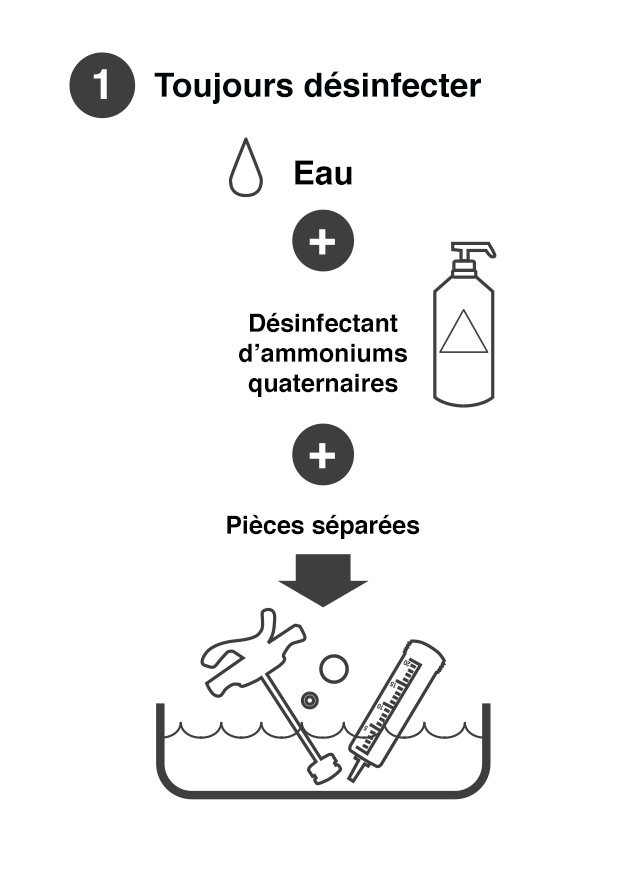
Regular maintenance is essential to ensure hygiene and extend the life of your syringe. Its fully disassemblable design makes it easy to clean each component. For detailed maintenance instructions, please refer to our user guide, available for download.

"cc" is short for cubic centimeter. One cubic centimeter is exactly equal to one milliliter (ml). These two units are interchangeable when measuring the volumes of injectable products.

After heavy use, the seals may wear out and compromise dosing accuracy. ARDES offers replacement seals designed for each model. Contact our customer service department and provide your equipment’s part number to receive the correct replacement part.

Syringes and dosing guns are packaged in three formats: individually in blister packs, in individual pouches, or in bulk in cartons for large orders. Identification tags are sold on trays, to facilitate handling on the farm, or in pouches.

Identification Tags

Visual fasteners—male, female, tamper-proof, or reusable: everything you need to know to choose and install your ARDES fasteners.

A visual identification tag consists of two complementary parts. The male tag has a prong (metal or plastic) that pierces the animal’s ear. The female tag receives the male prong and locks it in place to form a tear-resistant assembly. All ARDES female tags are compatible with all ARDES male tags. However, we offer pairs optimized for your specific identification needs: species, regulatory requirements, and desired lifespan.

Tête Bouchée (TB), tamper-proof tag: Once attached, the tag cannot be removed without being destroyed. This model, known as “Tamper Proof,” is used for official, regulatory identification. ARDES submits bids for government contracts using this type of tag.

Open-Ended (TO), reusable ear tag: The ear tag can be reused on another animal once the male end is cut off. These so-called non-tamperproof ear tags are popular for internal herd management.

Metal Tip (PM): Makes a clean, precise incision, ensuring long-lasting and reliable identification. Recommended for species with tough cartilage, particularly pigs, and for any heavy-duty use.

Plastic Tip (PP): a more economical option, but piercing requires more force. Tagging pigs with this type of tip is not recommended due to the hardness of their ear cartilage.

The retention rate measures a ear tag’s ability to remain securely attached to the animal’s ear over time, despite environmental factors such as friction, vegetation, and animal behavior. The higher this rate, the more reliable the ear tag is over time. It is a key criterion for selecting the right model based on the species and the type of livestock management.

Yes, ARDES ear tags are designed to fit most ear tagging pliers on the market. For optimal tagging—in terms of both precision and the animal’s comfort—we recommend using ARDES ear tagging pliers, which are specifically designed for our ear tags.

Proper application is essential to ensure the ear tag stays in place and to safeguard the animal’s well-being. The technique and placement on the ear vary by species: cattle, sheep, goats, or pigs. Check out our species-specific ear tagging guide, available for download.

ARDES offers four marking solutions to meet every need: regulatory traceability, farm numbering, and color marking. To learn more about each solution and its benefits, contact our team or download our resources.

Electronic tags and RFID tags

ICAR Standards, HDX and FDX Technologies, Benefits of Electronic Traceability: Master Animal RFID Identification.

ICAR (International Committee for Animal Breeding Performance Testing) has established the international standards ISO 11784 and ISO 11785 to standardize electronic animal traceability worldwide. Certification requires technical testing conducted by accredited independent laboratories. ARDES electronic ear tags are ICAR-certified, ensuring compliance with international regulatory requirements and interoperability with commercially available reading devices.

Both technologies comply with ISO standards but offer different levels of performance.

HDX (Half-Duplex): Offers a longer read range with both fixed and portable readers. Ideal for automatic sorting systems or bottleneck lanes.

FDX (Full-Duplex): lower initial cost, slightly shorter read range. Suitable for everyday use in livestock farming with a handheld reader.

RFID electronic identification helps optimize the management and profitability of your herd: automatic, contactless reading of identification tags; greater reliability compared to visual inspection; direct integration with livestock management software; automatic sorting in the sorting chute; individual weighing; treatment tracking; and compliance with national and international traceability regulations.

Didn't find the answer to your question?

Our team is available to assist you in selecting and using your equipment.